

CFFC staff team learn about CPR and Defibrillators
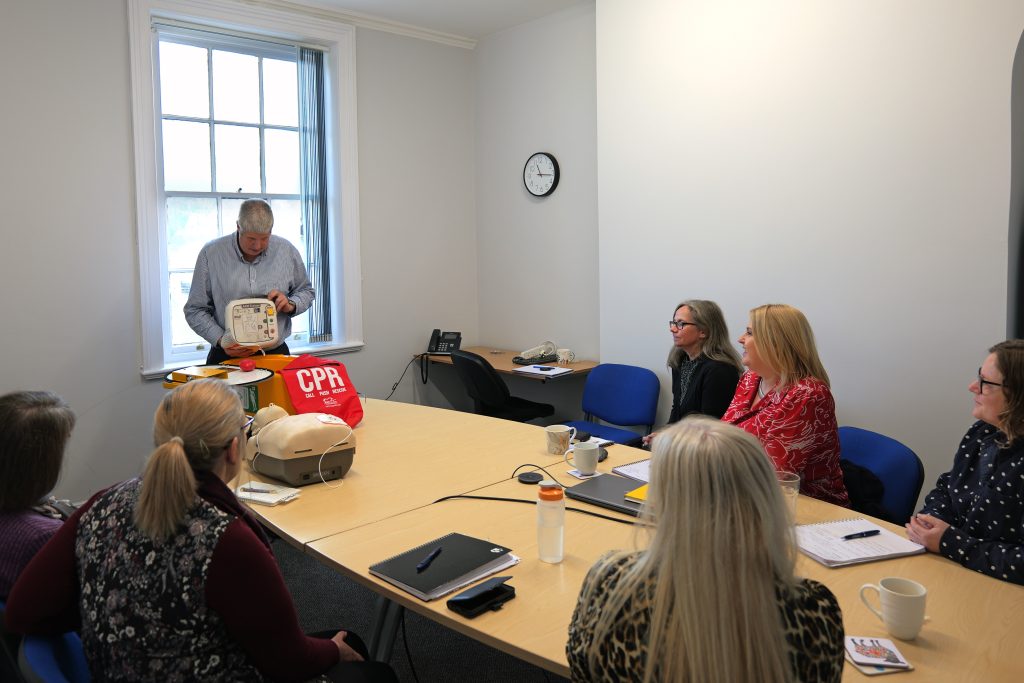
When you have a donor who is a cardiac arrest survivor, it’s not only humbling but it’s useful too especially when they agree to share their story and knowledge with you.
Neil Davidson has held a fund at the Community Foundation which pays for CPR training as well as defib awareness and equipment like replacement pads and batteries. With discretion, funding to pay for defibrillators can also be given, especially when the defib will be fully accessible to the general public 24/7.
Neil’s story and passion for saving lives were truly infectious. He started by asking if we knew the difference between a cardiac arrest and a heart attack. A cardiac arrest is when the heart stops beating suddenly. The lack of blood flow to the brain can cause the person to lose consciousness. A heart attack is when the heart has blocked arteries which restricts blood flow which in turn stops the heart from getting enough oxygen. Neil used the analogy of your heart being like a car and likened a cardiac arrest to a car breaking down very suddenly and completely stopping entirely, whereas a heart attack could be likened to a car engine spluttering and misfiring for a while, but still managing to keep going.
Neil brought a mannequin called a ‘Annie’ to give us hands on experience performing CPR. This gave us confidence we know where to do the compression on the chest, how to hold our hands, and most importantly how much pressure is needed (yes, it’s usual to break ribs when you are doing CPR). We also discussed the different songs you can use to help you get into a rhythm of dong the compressions which included “Staying Alive!” and “Nelly the Elephant”. By doing CPR compressions you are helping to pump the blood around the body to get oxygen to the brain.

Neil explained that as well as CPR being an acronym for the medical description, it also acts as a reminder of what to do if someone needs help;
- Call 999 and put it on speaker phone,
- Check to see if they are breathing by seeing if any breath is coming out of their mouth and put your hand on their chest. Push the chest with chest compressions. Interlock your hands or put them one on top of another and push down on their chest using maximum pressure.
- Revive by using a defibrillator.
One of the shocking statistics is that in the UK only 5% of people survive a cardiac arrest outside of hospital. That’s why it’s important to know where your nearest defibrillator is.
Make sure that you know where your nearest defibrillator is by visiting https://www.defibfinder.uk/
If you want to find out more about free CPR training or funding for a defibrillator, especially if it needs new pads or a new battery, please contact CFFC hello@cffc.co.uk and we will be able to give you more information.


